


2026 benchmark guide
How much do Facebook ads cost?
Meta never quotes you a price. You choose a daily budget, an auction sets the price of each click and each lead, and the Australian median click ran about $0.95 in the year to July 2026. This guide covers the benchmarks, sensible budgets, and real lead numbers from a trade campaign.
What do Facebook ads cost in Australia?
There is no rate card, but there are benchmarks. Across Australian accounts, the median click cost about $0.95 in the year to July 2026, reaching 1,000 people cost roughly $10 to $15, and the median lead ran about $50. Your numbers depend on your area, your ad and your offer.
| What you're paying for | Australian benchmark | Worth knowing |
|---|---|---|
| A click on your ad | $0.95 median for the year to July 2026, moving between $0.49 and $1.53 by month | The click is the cheap part. It only counts if it lands somewhere that turns it into an enquiry. |
| Reaching 1,000 people | $14.38 median for the year to July 2026, moving between $9.63 and $21.73 by month | Ad people call this CPM. It's the raw cost of attention, before anyone clicks. |
| A lead (a name and number) | $50.80 median across industries for the year to mid-2026, ranging from about $25 to $102 by month | An all-industries median. No neutral benchmark splits it out by trade, so the real trade number below matters more. |
-
A click on your ad
$0.49$0.95$1.53The high month costs about three times the low one.
-
Reaching 1,000 people
$9.63$14.38$21.73Called CPM: the raw cost of attention, before anyone clicks.
-
A lead (a name and number)
$25$50.80$102An all-industries median, which is why the trade campaign below matters more.
That median blends every industry, from sectors that pull leads for a few dollars to ones paying well over $100 a lead, and none of the published tables carries a line for trades. That is exactly why the real trade campaign further down this page matters more than any market average.
Benchmarks from Superads' published Australian Facebook ads dataset (year to mid-2026), retrieved July 2026. Full source list at the end of this page.
How does Facebook decide what you pay?
Facebook ads run on an auction. Every time someone opens their feed, advertisers compete for that moment of attention, and the price of your click or lead is whatever it took to win it. You control the total by setting a daily budget; the auction controls what each result costs.
One naming note: these ads run through Meta, which owns Instagram too, so one campaign can show in both feeds. Same auction, same budget, and the industry now says Meta ads. This page says Facebook because that's what everyone searches.
- Who you point it at. You pay for everyone the ad reaches, so "everyone within 100 km" spends most of its budget on people who can never book you. The tighter the audience matches the people who actually hire your trade, the less goes to strangers.
- What you ask them to do. A view is cheap, a click costs more, a lead costs more again. The benchmarks above are the same auction at three depths. Judge your ads on the deepest number, the lead, because that's the one that buys work.
- How good the ad is. Results divide the spend. If one ad pulls ten enquiries where another pulls one from the same money, your cost per lead just dropped by ninety percent. Real job photos and a plain offer are usually the difference.
What does a Facebook lead cost?
Across Australian accounts, the median lead cost about $50 in the year to mid-2026, swinging between roughly $25 and $102 by month. No neutral benchmark splits that out by trade, though, so an all-industries median only gets you so far. The closest real number we can give you is a client's own campaign, below.
$14.16 a lead Mr Loo, a South East Queensland plumber: 303 enquiries from $4,291 of Meta ad spend, $14.16 each. Those ads drove $120k of extra work in three months, landing on a website rebuilt to convert. Read the case study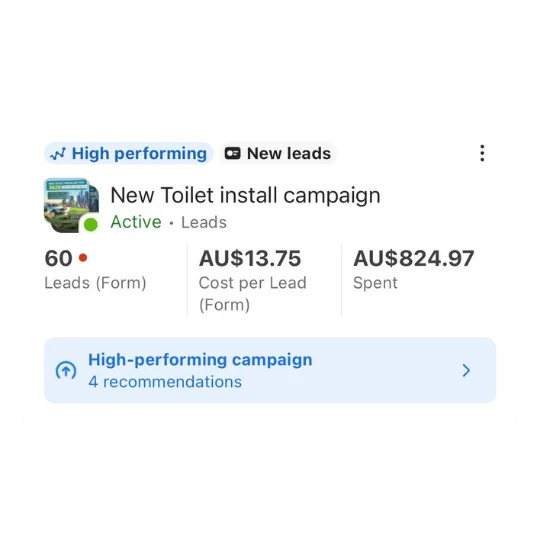
Cost per lead, same measure, same page
Bars share one scale. Mr Loo's leads came in below the whole national range, which starts at $25. One campaign in one trade, not a benchmark: it is what the right offer on a converting website can do.
Benchmarks tell you what a lead costs; only your own books tell you what one is worth. Work out your average job value and how many leads become jobs, and you have the number that matters: the most you can pay for a lead and still come out well in front. That number is a world apart for a gutter clean and a full bathroom renovation.
How much should you spend to start?
Less than you'd think to test, more than Meta's minimums to learn anything. Meta will technically run ads from about US$1 to $5 a day, but for a real test we'd put $30 to $50 a day behind each ad set, which is roughly $900 to $1,500 over a month.
| Stage | Daily spend | What it gets you |
|---|---|---|
| Meta's published minimum | About US$1 to $5 a day depending on how you're billed; up to US$40 for some campaign types | The ads run, technically. At around a dollar a click, small budgets buy a handful of clicks a day. |
| Testing | $30 to $50 a day per ad set (each ad-and-audience combination you test) | Enough to work out which ad and audience deserves real money, without burning budget while you learn. |
| Established | $100 to $500+ a day | Roughly where an established trade campaign sits once its cost per lead is proven and worth scaling. |
What makes Facebook ad costs blow out?
Rarely the auction itself. Costs blow out when the spend is pointed at the wrong people, the ad gives them no reason to stop, or the click lands somewhere that can't take an enquiry. All three are fixable, and all three are more common than an expensive market.
-
Targeting wider than the area you service.
"Everyone within 100 km" reads as reach and spends like waste: you're paying to show the ad to people you'd never quote. Set the area to where you actually work and let the budget concentrate.
-
An ad nobody stops on.
Feeds move fast. A stock photo with a logo slides straight past; a real job, a real crew or a real before-and-after gets the thumb to pause. If the ad can't stop a scroll, the auction still charges you for the views.
-
The click has nowhere useful to land.
Sending paid clicks to your Facebook page or a slow homepage is a common leak. You pay for the click either way; the landing spot decides whether it becomes an enquiry. A page built for the offer, with a form and a phone number, is half the campaign.
-
Nobody is watching the numbers.
Costs move all year: reaching 1,000 people ran about 50% dearer in November 2025 than the year's median. A set-and-forget budget spends the same through the dear weeks, and nobody notices the leads thinning out until the bill arrives.
Facebook ads or Google Ads?
They do different jobs. Google Ads catch people already searching for your trade, so intent is high and the lead is warm. Facebook ads put an offer in front of people who weren't looking, which suits work people put off or don't know to search for. Plenty of trade businesses run one, not both.
- Facebook fits offer-led work you can show in a photo. The toilet-install campaign above put a specific job in front of people who weren't searching for it, at $14.16 a lead from Meta ad spend.
- Google fits searched-for work. Blocked drains, burst pipes, a dead hot water system: someone typing those words wants a tradie today, and Facebook can't match that intent. Start with our Google Ads for trade businesses page if that's your work.
- If the budget only covers one channel, match it to how your jobs start. Searches go to Google, offers go to Facebook. The longer trade-offs are in SEO vs Google Ads and the full advertising for tradies guide.
Does KINGTRADIE run Facebook ads?
Yes. The Mr Loo campaign on this page is ours: Meta ads paired with a new website and local SEO, because the three feed each other. The ad finds the person, the website wins their trust, and your Google listing catches the ones who search your name after seeing the ad.
No prices on this page because there's no honest one-size number. It's a fixed quote after a call, once we know your trade, your area and what a job is worth to you.
- The ad account, the page and every lead stay yours, in your name
- No lock-in contracts
- Plain reporting: leads and what they cost, never vanity charts
Facebook ad cost questions?
Five straight answers, sourced and dated.
How much should I spend on Facebook ads?
For a real test we'd put about $30 to $50 a day behind each ad set, roughly $900 to $1,500 a month. Run it long enough to judge cost per lead against what a job is worth to you, then scale what works and kill what doesn't.
Are Facebook ads worth it for a trade business?
They can be, with the ad, the offer and the landing spot all working. One of our plumbing clients pulled 303 enquiries from $4,291 of Meta ad spend, $14.16 each, and those ads drove $120k of extra work in three months through a website rebuilt to convert.
How much do Facebook ads cost per click in Australia?
About $0.95 for the median Australian click across the year to July 2026, by one large published benchmark, moving between $0.49 and $1.53 month to month. A click is only the entry price; turning it into a lead depends on your ad, your offer and where the click lands.
Can I run Facebook ads myself?
Yes, and plenty of owners do. Boosting a post takes two minutes; the harder parts are picking the audience, making an ad people stop on, and giving the click somewhere to land. Budget for a learning period where some spend buys lessons instead of leads, and start small.
Why are my Facebook ads not getting leads?
Check where the click goes first: paid traffic sent to a Facebook page or a slow website with no clear way to enquire dies there. Then look at the offer (is it something people act on?) and the targeting (are you paying to reach people outside your area?).
Where these numbers come from
- Meta developer documentation, daily budget rules, retrieved July 2026
- Meta Business Help Centre, minimum budget guidance (confirmed via published 2026 guides), retrieved July 2026
- Superads Australian Facebook ads benchmark, median cost per click, July 2025 to July 2026, retrieved July 2026
- Superads Australian Facebook ads benchmark, median cost per 1,000 reached, July 2025 to July 2026, retrieved July 2026
- Superads Australian Facebook ads benchmark, median cost per lead, July 2025 to June 2026, retrieved July 2026
Figures retrieved July 2026. Benchmarks move monthly (the Superads dataset is a rolling window); check the source pages for current numbers. The Superads click, cost-per-1,000 and cost-per-lead benchmarks publish dollar figures without naming the currency; treat them as indicative. Meta's minimums are US dollars.
Want these numbers for your own trade?
Bring your trade and your area. We'll tell you what a lead should cost you, whether Meta ads fit the work you want more of, and what we'd run if they do. If it's not your channel, we'll say that too.
Book a call